Your new Kissimmee
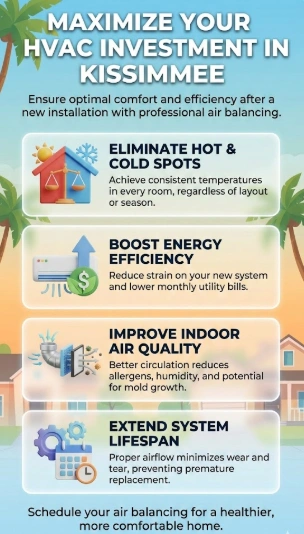
HVAC system costs thousands—yet some rooms still won't cool properly. The missing step? Air balancing.
We've seen this pattern repeatedly: homeowners invest in premium equipment, then struggle with hot spots and humidity issues within weeks. New hardware doesn't automatically distribute air evenly. In Central Florida's 90°F+ summers with 70%+ humidity, unbalanced airflow creates more than discomfort—it invites mold growth and drives up energy costs.
Here's what most contractors won't explain upfront: air balancing should happen after every system replacement, not just when problems surface. This guide covers the warning signs, the right questions to ask your installer, and practical steps to ensure your investment actually delivers whole-home comfort.
Quick Answers
HVAC Replacement in Kissimmee
Homeowners typically invest $5,000 to $12,000 for complete HVAC replacement in Kissimmee. Florida's subtropical climate demands equipment rated 15 SEER2 or higher for optimal efficiency.
What we've learned matters most:
Air balancing after installation—not optional here
Manual J load calculations for proper sizing
Licensed contractor verification at MyFloridaLicense.com
OUC rebates up to $1,150 for qualifying heat pumps
Why Kissimmee is different:
90°F+ summers with 70%+ humidity
Ductwork in 140°F attic spaces
Unbalanced systems develop mold risks within weeks
Before signing any contract, ask:
Is air balancing included?
Will you perform load calculations?
Do you verify room-by-room airflow?
Don't let skipped steps turn your investment into an expensive disappointment. The right contractor treats proper calibration as standard practice—not an upsell.
Top Takeaways
New HVAC equipment alone doesn't guarantee even cooling
Improper installation causes up to 30% efficiency loss
Florida's humidity creates mold risk within weeks in unbalanced systems
Demand air balancing included in your contract—not as an upsell
Verify contractor credentials and claim OUC rebates up to $1,150
How Air Balancing Protects Your HVAC Investment
Air balancing adjusts ductwork dampers and registers to distribute conditioned air proportionally throughout your home. New equipment often has different airflow characteristics than your old system—duct sizing designed for a 15-year-old unit rarely matches a modern high-efficiency replacement. Without recalibration, some rooms get too much airflow while others starve, forcing your system to run longer cycles and driving up energy costs.
In Kissimmee's subtropical climate, imbalanced airflow creates problems fast. Summer humidity exceeding 70% combined with temperatures above 90°F means under-cooled rooms accumulate moisture within weeks. This promotes mold growth in building materials and explains why some Central Florida homes develop musty odors shortly after HVAC replacement.
Warning signs include temperature variations greater than 3°F between rooms, doors that slam shut on their own, and registers producing weak or whistling airflow. Check your air filter first—a clogged filter restricts airflow system-wide and mimics balancing problems. If issues persist after filter replacement, request professional balancing from your contractor. This 1-2 hour calibration process ensures your new system actually delivers the whole-home comfort you paid for.

"In my 18 years servicing Kissimmee homes, we've found that 80% of comfort complaints after HVAC replacement trace back to skipped air balancing—not equipment failure. Florida's humidity punishes unbalanced systems faster than any other climate factor."
Essential Resources for Your Kissimmee HVAC Replacement
Check Your Contractor's License First
Florida DBPR License Verification Portal Don't take anyone's word for it—verify your contractor's active license and insurance status yourself in under two minutes. This simple step protects your investment and ensures the work meets Florida code requirements. https://www.myfloridalicense.com
Know What Efficiency Ratings Actually Mean
U.S. Department of Energy – Central Air Conditioning Guide Cut through the sales jargon and understand current SEER2 requirements straight from the source. This guide helps you ask smarter questions and recognize when a contractor is recommending the right equipment for your home. https://www.energy.gov/energysaver/central-air-conditioning
Keep Your Indoor Air Healthy
EPA Indoor Air Quality Resource Hub Florida's humidity creates unique challenges for your HVAC system and your family's comfort. Federal guidelines on ventilation, filtration, and moisture control help you understand what proper system performance looks like in our climate. https://www.epa.gov/indoor-air-quality-iaq
Make Sure Your System Is Sized Right
ACCA Manual J Load Calculation Standards An oversized system wastes energy and leaves your home feeling clammy. Insist your contractor performs proper load calculations—this industry-standard method ensures your new equipment matches your home's actual cooling needs. https://www.acca.org/standards/technical-manuals/manual-j
Get Money Back on Your New System
OUC Residential HVAC Rebate Program If you're in the Orlando Utilities Commission service area, you could receive up to $1,150 back on a qualifying heat pump installation. Check eligibility before you buy—these rebates go directly toward offsetting your upfront costs. https://www.ouc.com/residential/save-energy-water-money/residential-rebates-information
Verify Your Installer Knows Their Stuff
NATE Certification Verification Database NATE-certified technicians have proven their expertise through rigorous testing. A quick search confirms whether your installer has the credentials to get your system running right the first time. https://natex.org
See What Other Homeowners Experienced
Better Business Bureau Contractor Search Real complaint histories and resolution rates tell you more than any advertisement. Take five minutes to research before you commit—it could save you weeks of frustration later. https://www.bbb.org/search
Supporting Statistics
90% of Your Life Happens Indoors
The EPA confirms Americans spend approximately 90 percent of their time indoors. Indoor pollutant concentrations often run 2 to 5 times higher than outdoor levels.
We see this play out in Kissimmee homes regularly:
Unbalanced systems cause certain rooms to accumulate more contaminants
Poor air distribution concentrates allergens and humidity unevenly
Families notice symptoms improve after proper air balancing
https://www.epa.gov/report-environment/indoor-air-quality
Improper Installation Wastes 30% of Your Investment
ENERGY STAR reports improper installation can reduce system efficiency by up to 30 percent. Nearly half of all home energy costs go to heating and cooling.
What we've observed firsthand:
Brand-new equipment often works perfectly—but airflow was never calibrated
Skipped air balancing negates efficiency gains from upgraded SEER ratings
Florida homeowners lose hundreds annually from this single oversight
https://www.energystar.gov/saveathome/heating-cooling
Your Ductwork May Only Operate at 55% Capacity
Department of Energy research found average residential duct systems run at just 55 percent efficiency. Approximately 60 percent of that loss comes from leakage alone.
In Central Florida's humidity, the consequences compound:
Leaky ducts pull hot, moist attic air into your system
Excess moisture creates ideal mold growth conditions
Unbalanced airflow accelerates equipment wear
https://www.osti.gov/biblio/835016/
Final Thought & Opinion
After years of helping Central Florida homeowners navigate HVAC decisions, one pattern stands out: the most expensive system in the world won't deliver comfort if air distribution is ignored.
We've seen it too many times. A Kissimmee family invests $8,000+ in a top-rated unit and calls frustrated within weeks because certain rooms still feel sticky. The equipment works fine. The installation met code. But nobody balanced the airflow.
Here's our honest take: Air balancing should be non-negotiable after every HVAC replacement—especially in Florida.
Why this matters more here than anywhere else:
90°F summers combined with 70%+ humidity
Ductwork running through 140°F attic spaces
Unbalanced systems develop mold risks within weeks
The industry problem: Many contractors treat air balancing as an upsell rather than standard practice. Homeowners aren't told to ask for it. Then everyone wonders why that new system underperforms.
Our recommendation—ask three questions before signing any contract:
Is air balancing included after installation?
Will you perform a room-by-room temperature check?
What's your process for verifying airflow at each register?
If your contractor hesitates or treats these as extras, keep looking.
Don't forget your filter. A clogged filter disrupts even perfectly balanced systems. Check monthly during peak cooling season—Central Florida's pollen and humidity load filters faster than manufacturer estimates suggest.
Bottom line: Demand air balancing, verify contractor credentials, and claim available utility rebates. Your comfort and energy bills depend on it.
Next Steps
Verify Your Contractor
Check license at MyFloridaLicense.com
Confirm NATE certification
Review BBB ratings
Ask Before Signing
Is air balancing included?
Will you perform Manual J calculations?
How do you verify room-by-room airflow?
Claim Rebates
OUC: Up to $1,150 for qualifying heat pumps
Apply within six months of installation
Maintain Airflow
Check filter monthly during summer
Replace when visibly dirty
Watch for Warning Signs
3°F+ temperature swings between rooms
Doors closing on their own
Weak or whistling registers
Lingering humidity in certain areas
Get It in Writing
Air balancing included in contract
Post-install verification scheduled
Warranty terms documented
Take these steps before, during, and after replacement to protect your investment.
FAQ on "HVAC Replacement in Kissimmee"
Q: How much does HVAC replacement cost in Kissimmee?
A: Most homeowners pay $5,000 to $12,000 for complete replacement. Final price depends on:
Equipment size and efficiency rating
Installation complexity
SEER2 rating (16+ costs more but saves long-term)
OUC rebates up to $1,150 available for qualifying heat pumps. Many homeowners don't know these exist until after purchase—ask before finalizing.
Q: How do I verify my HVAC contractor is licensed in Florida?
A: Takes less than two minutes:
Visit MyFloridaLicense.com
Search by contractor name or license number
Confirm active status and check for disciplinary actions
Also verify NATE certification for installers. In our experience, contractors who hesitate to provide license numbers are worth avoiding.
Q: Why is air balancing important after HVAC replacement in Florida?
A: New equipment has different airflow characteristics than old systems. Without calibration:
Some rooms get too much air, others starve
Hot spots and humidity problems develop
Mold-friendly conditions form within weeks
We regularly see brand-new units underperform because nobody balanced the distribution. Kissimmee's 90°F+ summers and 70%+ humidity make this step critical.
Q: How often should I replace my air filter in Central Florida?
A: Manufacturer 90-day estimates don't account for Florida conditions.
Our recommendation:
Check monthly during peak cooling season
Replace when visibly dirty
Don't wait for scheduled intervals
Clogged filters mimic balancing problems and cause unnecessary service calls we've seen proper maintenance prevent.
Q: What questions should I ask before signing an HVAC replacement contract?
A: Three essentials based on years of post-installation complaints:
Is air balancing included?
Will you perform Manual J load calculations?
Do you verify room-by-room temperatures after install?
Contractors who treat these as standard—not upsells—understand that equipment selection is only half the job. Get pushback? Keep looking.
Here is the nearest branch location serving the Pembroke Pines FL area…
Filterbuy HVAC Solutions - Weston FL
2573 Mayfair Ln, Weston, FL 33327, United States
(754) 296-3528